
Link to: Resource Guide
Why do toddlers always get hurt?
Toddlers are particularly accident-prone for a few reasons:
- They’re ridiculously fearless and brave
- They’re very, very curious
- They’re top-heavy (ie, very big brains/heads, not so big bodies)
- They don’t have very good depth perception (ie, sure, I can climb off of this very high table, the ground’s not that far away … no big deal)
- They like to copy you but don’t exactly know how to do what you do
Despite my general awareness of toddler safety, Wrenʻs still had many injuries in her short life, including falls off beds and couches, trips and spills onto the ground, and running straight into hard things (counters, walls, etc).
As an aside, how can she not see whatʻs coming and stop herself before the collision? It always feels like itʻs happening in slow motion but Iʻm never fast enough to catch and save her! So bumps and bruises abound!
How to stay safe
It’s difficult to watch your kiddo constantly (which seems like what they need). I turn my back for a second sometimes and hear some sort of commotion to bring my attention back to her (ie, some sound like crash, slam, splat, or splash).
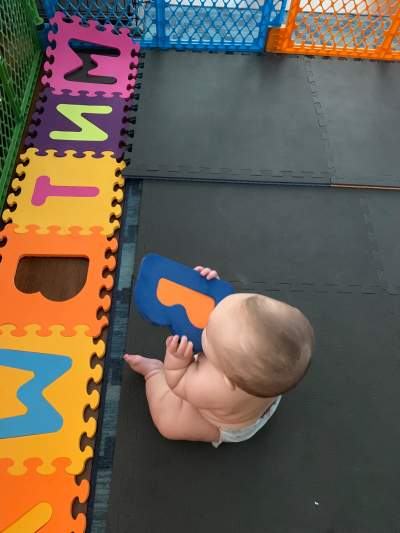
For a toddler or infant just learning to get on their feet, I recommend containment and lots of soft landing pads. This was our set up for Wren as she was learning how to cruise. She fell A LOT but landed softly and built her confidence in the process. I know real estate can be tight (this took up our entire living room), but it’s nice to know she has limited access to things that could hurt her.
Other common accidents besides falls are scald burns (from hot liquids) and ingestions (swallowing something not meant for swallowing).
- To prevent scald burns, always push hot liquids in and don’t assume they won’t grab it because they know it’s hot (even if you warned them). Avoid tablecloths (kids yank on these and hot contents go flying).
- To prevent ingestions, it’s always a good habit to get down on your hands and knees and see from your kid’s point of view all the things we easily forget about (dropped coins and vitamins, small toys an older sibling left lying around). Little ones have a radar it seems to hone in on the tiniest of things … and they always want to put it in their mouth!! (or nose or ear…). And please absolutely put the phone number for POISON CONTROL in your phone now: 1-800-222-1222. Trust me.
The big one.
We absolutely encourage lots of other safety precautions, too: wearing your seatbelt, appropriate fit and use of a carseat, wearing your helmet, crossing-the-street safety, and stranger safety. We try our best to review all of the age-appropriate preventable accidents during our visits. But, the big one is water safety.
Not to be doom and gloom, but the fact is that accidental drownings are the #1 cause of death for children ages 1-4 in the US, ahead of motor vehicle accidents. Not only at the beach, drownings can also occur at home, in the bathtub, toilet, buckets, and outdoor swimming pools. You’ve probably heard it, and it’s true, a child can drown in just 1″ of water, so any water, even in your home, can put your child at risk.
Some water safety tips:
- If you have a swimming pool at home, it should be behind a 4′ fence surrounding all sides a self-closing and self-latching gate.
- If you’re out in the pool, there should be one designated adult that is completely undistracted (NO phone) whose sole responsibility is to watch your kid, and it should be stated out loud who that person is. Many adults will assume that someone else is watching, but everyone should know exactly who.
- NEVER leave a child unattended in water (ie, don’t leave the room, even for a second, because you forgot to grab x,y, or z). A child in or near water should always be within arm’s length of an adult.
- Consider toilet locks or door/knob locks in order to limit kid’s access to water
- Don’t assume that drowning will be obvious (most kids drown silently, not dramatically like in the movies)
- Swimming lessons can decrease the risk of dying from drowning, but is not a substitute for good supervision (most kids are capable of learning actual swim strokes around age 4)
- Unless it’s a coast-guard approved life vest, no flotation device will save a child from drowning, so don’t let those devices give you a false sense of security when kids are in the water
- Empty out buckets and kiddie pools immediately after use and store them upside down so they don’t collect water
The most important thing we do as pediatricians is PREVENTION, so at every well check, we’ll talk about these safety precautions that you can take to make sure your child is in an environment that will keep them protected and healthy. Here’s a great article on child-proofing your home.
Reach out anytime with questions, we’re here for you!