

Previsit Questionnaire
Please complete this form before your Well-Child Visit.
Bright Futures Handouts
Here are some suggestions from Bright Futures experts that may be of value to your family.
Immunizations
Here are the immunizations recommended by the AAP for children of this age: Hepatitis B, RSV.
- View the complete immunization schedule.
Welcome, parents.
If you’re reading this with a baby on your chest and no idea what day it is, you’re in the right place. This portal is everything we’d tell you in our office if we had three uninterrupted hours instead of thirty minutes. Skim it now, and bookmark it for later. Come back at 3am when you need it most (or when you have time to think). We’ve got you.
What happens at this visit?
What we’ll do
- Weight and growth check
- Physical exam
- Feeding and sleep check-in
Vaccines & preventives
- Hepatitis B is most often given in hospital, but we’ll confirm.
- RSV protection (Nirsevimab/Beyfortus) if your baby didn’t get the shot in the hospital or you didn’t get RSV protection during pregnancy. RSV season is year-round in Hawaiʻi.
Screenings we’ll review
- Newborn metabolic screen
- Newborn hearing screen
- Jaundice level if needed.
Bring with you: A feeding log (on paper or in your app of choice), your top 3 questions, a support person. And yourself, exactly as you are. Sweatpants encouraged.
What is my baby doing at this age?
Body
- Sleeping 16 to 18 hours a day in short bursts
- Feeding every 2-3 hours, day and night
- Losing a little weight in the first week, then climbing back to birthweight by 2 weeks.
Brain
- Recognizing your voice
- Tracking faces 8-12 inches away (that’s the perfect distance from your face when you’re feeding)
- Calming to touch, because skin-to-skin contact is the BEST.
Behavior
Crying is communication, not commentary on your parenting. The total daily crying curve peaks around 6-8 weeks, then drops. You’re not breaking your baby. Your baby is a ball of instincts, and every time you meet their cries of “I’m hungry! I’m lonely! I’m cold! I’m dirty,” they realize you’re their people. Keep up the great work!
🌿 Mind / Body / Spirit, for your keiki
🌟 What’s the most useful resource for new parents in this newborn period?
The Happiest Baby on the Block is a book, website, and app by Dr. Harvey Karp explaining the 5 S’s (swaddle, side, shush, swing, suck) and will get you through the witching hour and help calm your baby. (Remember: side and stomach are for calming a baby you’re holding, never for sleep. Always back to sleep.) Read the book or get the app. Either is helpful.
How do I put my newborn to sleep safely?
The rule of thumb for safe newborn sleep is: back to sleep, alone in the crib, nothing else in the crib. Read these NICHD Safe to Sleep guidelines and follow them. Re-read it every few weeks as your baby gets stronger (and more determined to roll). Here’s a great article by Dr. Craig Canapari that also talks about establishing sleep routines at these early stages.
What’s the Period of Purple Crying?
This period, which often occurs between 2 weeks and 2 months of life, describes a well-known stretch of newborn fussiness, also known as the Period of PURPLE Crying. Some babies cry a lot, and it’s normal, but it’s also exhausting. This website explains why the period exists and helps protect against shaken baby syndrome. Share it with anyone who’ll hold your baby alone.
What resources can help with breastfeeding?
The best support is hands-on at this stage in your breastfeeding journey, with a board-certified lactation consultant. See our local resources section for recommendations. Online, KellyMom is an IBCLC-reviewed, evidence-based breastfeeding website and the right thing to read at 2am when something feels off with feeding.
Paced Bottle Feeding can also help as your child is learning to breastfeed. Whether you’re combo feeding, exclusively bottle feeding, or planning to return to work in a few months, paced bottle feeding protects baby’s hunger cues and your milk supply.
What’s the best way to burp my baby?
There are several safe ways to help your baby clear air from their stomachs if they swallowed any during feeding. Here’s a great article on burping your baby from the AAP.
How do I bathe my baby for the first time?
When all you want to do is bundle your baby and keep them warm, it can feel daunting to tackle bathing. This article walks you through what to do step by step. Don’t forget though, at this age your baby isn’t stinky or sweaty, and since you’re wiping down their dirty bits all day long, you definitely don’t need to bathe them as often as you think.
What’s the best way to care for my baby’s skin, nails, and hair?
Baby hygiene can feel overwhelming but easy care tips can be found in the following articles:
- Newborn nail care
- Care of the umbilical cord
- Diaper rash and skin care for newborns
- More on cradle cap, birthmarks, and heat rash
How can I support my newborn’s brain development?
Development starts from day one, with your touch and your voice (more on skin-to-skin in the bonding section below). There are many resources to help support your child’s development in the coming years.
- Pathways.org for educational videos, checklists, and a useful app to help you keep track as your baby’s brain grows!
- CDC’s Milestones Tracker app for checklists and guidance
💗 Family / Community, for you and your ʻohana
🌟 What books can help me prepare for taking care of my baby?
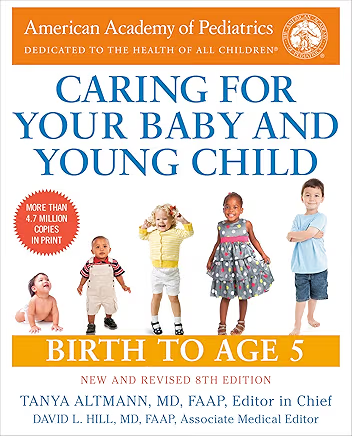
The reference book every new parent should own is Caring for Your Baby and Young Child. Not the most fun read, but the most reliable one.
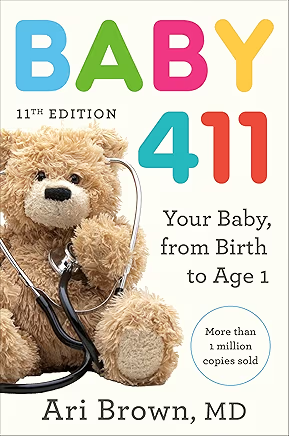
A very close second read for the first year specifically would be Baby 411, a quick reference book covering lots of important topics in infancy, written by an experienced pediatrician!
What are the best ways to bond with my baby?
Skin-to-skin works neurologically to promote bonding between parents and newborns. The article shows you how to do it safely and why dads/partners get the same hormonal benefit as moms. Bonus: it’s a free intervention, and you already have everything you need.
This isn’t my first baby. How can I prepare my children for a new sibling?
Bringing your baby home to older siblings requires more preparation. Read this article to help your older children adjust to their new little brother or sister.
Your wellbeing is part of this visit
Right now every eye is on the baby, and we want one on you too. The first weeks are physically and emotionally huge, and the baby blues (weepy, wrung-out, up and down) are common and usually ease by about two weeks. If they don’t, or if you feel worse than that, tell us. Postpartum depression and anxiety are common, treatable, and not your fault. The resources below are here whenever you need them.
- Postpartum Support International (phone: 1-800-944-4773). Free, confidential, available in English, Spanish, and 60+ languages via interpreter. For mothers, fathers, partners, adoptive parents. Text or call anytime. They won’t judge, they’ll help.
- National Maternal Mental Health Hotline. Moms can also get help by calling or texting 1-833-TLC-MAMA (1-833-852-6262) anytime.
- Edinburgh Postnatal Depression Scale (EPDS). A 10-question self-check we’ll also do at your visits. Take it now and again at 6 weeks. Postpartum depression and anxiety hit roughly 1 in 7 new parents. You may need support, and we want to be there for you.
- Postpartum Emotions & Baby Blues. Learn the difference between the baby blues (real, common, time-limited) and postpartum depression/anxiety (real, common, treatable). Please read this article, and share it with your partner. There are more resources at the bottom of the article as well.
- Crisis resources: 988 (call or text) or Hawaiʻi CARES 808-832-3100. If you have thoughts of harming yourself or your baby, call 988 or 911 now.
Local Oʻahu resources 🌺
What parenting resources are available locally?
🌺 Healthy Mothers Healthy Babies Coalition of Hawaii: Piko Pals. Free, drop-in, evidence-based parent support groups across the island. The single best place to meet other new Oʻahu parents going through the same stages you’re going through.
🌺 Family Hui Hawaii. Strengths-based parenting groups, free, all over the island. Sometimes medicine is time with other parents.
🌺 The Parent Line Hawaii. Free, confidential support from trained parent specialists and a comprehensive resource directory. Call when you don’t know what’s wrong and need help figuring it out.
What support is available for military families?
🌺 New Parent Support Program for Military Families. Home visits, free classes, parenting support specifically for military families on Oʻahu. Sign up early; spots fill.
Where can I learn more about nutrition support for my family?
🌺 WIC Hawaii. If you qualify, sign up. Even if you think you might not qualify, check. Hawaiʻi income limits are higher than you’d guess, and WIC includes lactation consultant support, not just formula.
What childcare resources are available?
🌺 Mālama Ola & PATCH Hawaii. Native Hawaiian-rooted family support and child care resources. Both worth knowing about, even if you don’t need them this month.
🚨 When to call us
Call us right away (or go to the ED) for any of these in a baby under 2 months:
- Fever 100.4°F (38°C) or higher (rectal). In a baby this young, call us for any fever, especially urgent under 28 days.
- Refusing to feed for more than a few hours, or fewer than 6 wet diapers in 24 hours after day 5
- Worsening yellow body color (jaundice), or any green-tinged vomiting
- Breathing that’s fast (>60 breaths/min at rest), labored, grunting, or with chest/ribs pulling in
- Floppy, hard to wake, or inconsolable crying for 3+ hours
- Any bleeding from the umbilical stump beyond a few drops, or redness spreading around it
- Your gut says something is wrong. Call. That’s what we’re here for.
📞 Call us when you need us: 808-600-2180
During office hours, you’ll reach our team. After hours, call the same number and select option 1 for our after-hours line (Hello Pediatrics), who follow our medical protocols.
For anything life-threatening, call 911.
What’s ahead in your first weeks
At our next visit, we’ll do another weight check, talk about how feeding is settling in, and set you up for the bigger transitions ahead. Between now and then, nobody expects you to have it figured out. The goal is fed, safe, and loved. That’s it. Everything else is bonus.
Things to notice between now and then:
How your baby calms down. Every baby has a slightly different “off switch,” maybe swaddling, motion, sound, skin-to-skin, or a favorite position. Once you crack the code, celebrate!
Nocturnal is normal for now. Eventually they’ll become less nocturnal and even give you a 4-hour stretch of sleep that will feel like a dream!
More activity. Longer stretches of awake time are coming up soon, so you can go outside and get some fresh air and sunshine, do tummy time, and just talk story with your little one. Even though they can’t understand everything yet, your attention + your words = brain fuel!!
Witnessing your baby’s brain forming millions of connections is nothing short of miraculous! Enjoy this fleeting time. 🥺
If something on this page didn’t answer your question, please message us. The portal is a starting place, not a replacement for us.